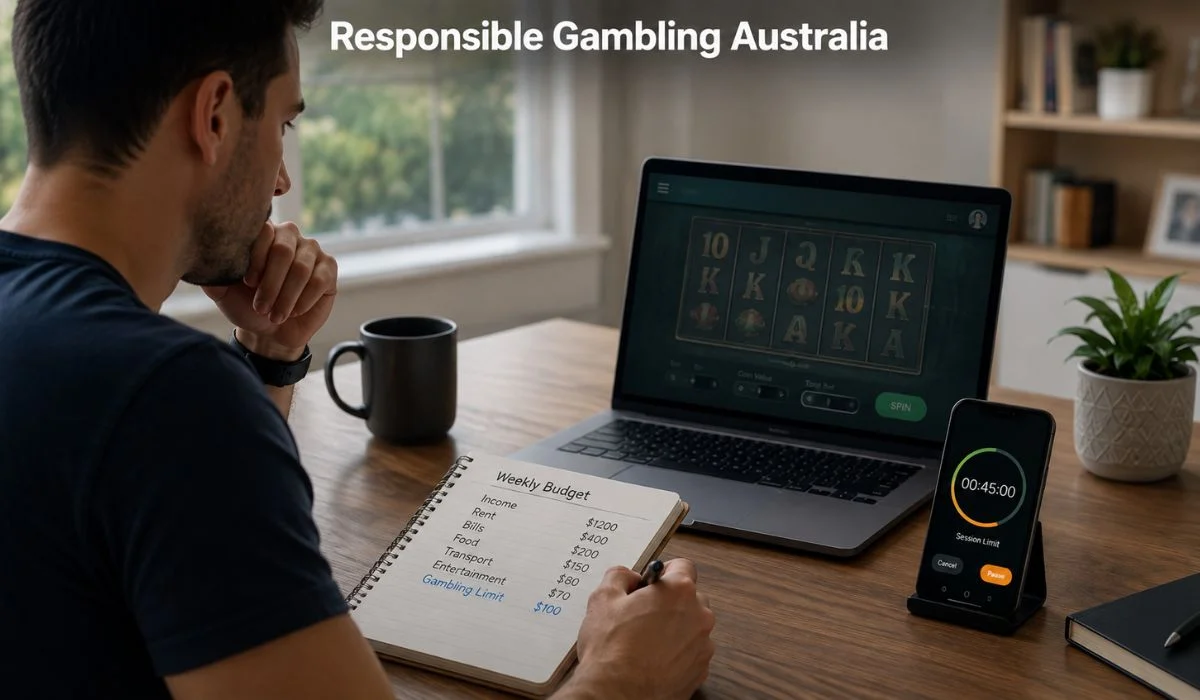
You learn to spot it. The player who’s there when your shift starts and still there when you’re clocking off. The one who doesn’t look up when the jackpot hits somewhere else. The one who asks to extend their credit limit for the fourth time in a month. It’s not dramatic. It’s ordinary-looking. That’s what makes it easy to miss until it isn’t.
When I left Crown to do independent compliance auditing, and then when I started this site, I made a decision: I wasn’t going to put a responsible gambling page at the bottom of a nav where nobody reads it, tick the box, and move on. This page is a working resource. It has the numbers you need, the tools that actually help, and the honest context that most of these pages skip.
Immediate Support
You do not need to have a gambling problem to call. These services help anyone who is worried about their gambling or someone else’s.
Free, confidential and available around the clock. Trained counsellors who specialise in gambling — not general mental health with gambling as an afterthought. Available by phone or webchat. Family members can call too.
Gambling Harm Isn’t All-or-Nothing
Most responsible gambling pages talk about “problem gamblers” as if they’re a separate species – people who made different choices and ended up in a different place. That framing misses the point. Gambling harm exists on a continuum. At one end: entertainment, no issues. At the other: significant disorder requiring clinical support. Most people who experience harm sit somewhere in the middle and don’t identify with either extreme.
| Risk level | What it looks like |
|---|---|
| No risk | Set budget, within means, stops on plan |
| Low risk | Occasional overspend, no significant harm |
| Moderate risk | Chasing, concealment, financial strain |
| Problem gambling | Persistent harm, unable to stop |

The people I was most concerned about on the floor weren’t the ones betting big. They were the ones who came back every day, kept to the same machine, and went quiet when you asked how they were going.
A Blunt Self-Assessment
These 10 questions are based on the Brief Biosocial Gambling Screen and the Problem Gambling Severity Index – the same instruments Australian health professionals use. Answer for the past 12 months. Your answers stay in your browser.
10-Question Self-Check
Answer Yes or No for each question based on the past 12 months.
Informational only — not a clinical diagnosis. If the result concerns you, Gambling Help Online: 1800 858 858 can help you work out what support, if any, is right for you.
How Pokies Are Designed to Hold Your Attention
Understanding why pokies are absorbing is more useful than simply being told to “set a budget”. These are not incidental features – they’re deliberate product design decisions made by game studios with decades of psychological research behind them.
Pokies pay out at unpredictable intervals – not fixed ones. Unpredictable rewards trigger stronger dopamine responses than predictable ones. This is the same mechanism behind social media notifications. You keep spinning because the next win might come.
When two jackpot symbols land and the third misses by one position, it activates the brain’s reward circuits almost as strongly as a win – but produces no payout. Game manufacturers include near-misses deliberately. They extend play without paying.
Betting 50 lines, winning back 20c on a $1.50 spin – the machine celebrates with sounds and animations. You ‘won’. But you’re down $1.30. The celebration is real; the win is not. This is among the most documented mechanics in pokies research.
A spin resolves in under 3 seconds. At that speed, a $5-per-spin session reaches $100 in under a minute of continuous play. The pace is a feature, not an accident – it maximises decisions per hour, which maximises revenue.
Physical pokies venues are famously clock-free. Online, there’s no external environment to anchor you in time. Session time limits exist specifically to reintroduce what the game design removes: awareness that time is passing.
“I’ve put $200 in, I may as well keep going.” This is the sunk cost fallacy. The $200 is gone whether you continue or stop. The machine has no memory of it. Continuing costs more money, not less.
None of this means you shouldn’t play. It means you should play with your eyes open – knowing what you’re up against, and using the tools that counteract it.
The Player-Protection Tools — and When They Actually Work
Casinos offer these tools. Most players don’t use them. The ones who do tend to set them up before a session, when they’re thinking clearly – not during one, when they’re not. Here’s what each does, and what it doesn’t.
| Tool | What it does | Takes effect | Can you undo it quickly? | Steve’s note |
|---|---|---|---|---|
| Deposit limit | Caps your AUD deposit per day / week / month | Immediately | 24–72hr wait to raise it | The cooling-off period is the point. Set limits when calm; the delay protects you when you’re not. |
| Loss limit | Locks your account once you hit a set loss amount | Immediately | Cooling-off required | More useful than deposit limits for stopping a chase, because it triggers on your actual losses – not just what you put in. |
| Session time limit | Auto-logs you out after a set duration | Immediately | Next login (usually) | The only tool that directly counteracts the no-clock design of pokies. Set it before opening the site. |
| Reality check | On-screen notification of time played and money wagered | Immediately | Dismissible on-screen | Easy to dismiss, which limits its power. Useful as a prompt, not as a hard stop. Pair it with a time limit. |
| Cool-off period | Temporary account suspension (24hrs–30 days) | Immediately | Cannot be shortened | Good for a break without a long-term commitment. If you’re finding you need these repeatedly, that’s a signal. |
| Self-exclusion | Closes your account for 3 months to permanently | Immediately | Not until full period ends | The most powerful tool. If you’re thinking about this, use it. Casinos we recommend treat exclusion requests as non-negotiable – they don’t ask you why. |
How to find these tools
Log into your casino account, then look for Settings, Responsible Gambling, Player Safety or Limits. If you can’t find them, contact live chat and ask. All casinos we recommend are required to surface these tools without friction. If you’re getting the runaround, that’s a red flag – let us know via the contact page.
BetStop: One Registration, Every Licensed Australian Wagering Operator
Self-exclusion is one of the most effective tools available for people who want to take a break or stop gambling altogether. In Australia, there are two main routes depending on where you gamble.
STOP
Register once at betstop.com.au and you’re excluded from every licensed Australian sports betting and racing site simultaneously. No separate applications. No contacting each operator. It takes about five minutes.
Registration is entirely online. No phone call required.
Name, date of birth and contact details. This is what links your exclusion to your betting accounts.
Minimum 3 months, up to lifetime. You can shorten it later, but only after the minimum has elapsed and only through a specific process. Longer is harder to reverse – which is the point.
All participating operators are notified and your accounts are suspended. Confirmation arrives by email.
BetStop covers licensed Australian wagering operators (sports betting, racing). It does not cover offshore online casinos, which is where most pokies sites operate. For those, self-exclude through each site’s account settings directly – or contact live support.
Self-excluding from offshore online casinos
Offshore casinos (including most online pokies sites) are not covered by BetStop. To self-exclude from an online casino, log into your account and look for the Responsible Gambling or Player Protection section in your account settings. You can usually select a self-exclusion period ranging from 24 hours to permanent.
If you can’t find this option, contact the casino’s live chat or email support and request a self-exclusion directly. All casinos we recommend are required to process self-exclusion requests immediately upon request.
What Problem Gambling Actually Looks Like
These aren’t just “warning signs” – they’re the pattern. Any single one, in isolation, may be nothing. Three or more together, consistently, is a different picture. The self-assessment above tests for these specifically.
Going back specifically to recover money lost in a previous session. This is the most reliable precursor to significant harm – each spin is independent, so chasing never works, but it feels like it might.
Rent, bills, food, family expenses. Once gambling has entered the household budget, the relationship with it has changed.
Credit cards, loans from family, selling possessions. The escalation from “spending gambling money” to “funding gambling with borrowed money” is a significant step.
Hiding how much time or money is spent, clearing browser history, lying about whereabouts. Concealment is a strong signal – it means some part of you knows it’s a problem.
Needing bigger bets to feel the same level of engagement. This mirrors the tolerance pattern of other addictive behaviours.
Planning to play for an hour, still going three hours later. Setting a budget and exceeding it consistently, even after deciding not to.
Opening the casino when stressed, bored, lonely or anxious – not for entertainment, but to feel different. This is where gambling harm and mental health typically intersect.
Feeling bad about gambling behaviour, but continuing anyway. The gap between knowing something is wrong and being able to stop is a characteristic feature of addiction, not a character flaw.
Thinking about gambling – past sessions, next sessions, how to fund the next deposit – when you’re not gambling. The game running in your head between sessions.
One sign on its own, occasionally, isn’t necessarily cause for concern. But if several of these are recognisable, the conversation with a counsellor at Gambling Help Online (1800 858 858) is worth having – they’ll help you work out what level of support, if any, makes sense.
Australian Support Services
Every service listed here is free. None of them require you to identify yourself as a “problem gambler” to access them. You can call to think something through, not just in a crisis.
Australia’s national gambling counselling line. Trained counsellors who specialise in gambling – not general mental health with gambling as an afterthought. Available by phone or webchat. Family members can call too.
Anxiety and depression support. Gambling harm and poor mental health run in both directions – each makes the other worse. Beyond Blue is the right call when gambling has merged with something deeper.
Crisis support and suicide prevention. If gambling harm has reached a crisis point – financially, emotionally, or in terms of safety – Lifeline is the right number to call first.
Free financial counselling from independent advisers. Gambling-related debt is common and complicated – credit cards, family loans, overdue bills all at once. These people know how to help you untangle it.
If someone else’s gambling is affecting you, there’s dedicated support. Gambling Help Online has specific counselling for families and partners – not just “how to help them”, but how to protect yourself and make decisions about the situation.
Australia’s national self-exclusion register. One registration excludes you from every licensed Australian sports betting and racing operator. Takes about five minutes and applies immediately.
Australian Gambling Law: What It Means for You as a Player
Australian gambling law operates across both federal and state levels. Understanding the framework helps you make informed decisions about where and how you play.
The Interactive Gambling Act 2001
The Interactive Gambling Act 2001 (IGA) is the primary federal law governing online gambling in Australia. It prohibits Australian-based companies from offering interactive casino games (including pokies) to Australian residents without appropriate licensing. It does not make it illegal for you, as a player, to access offshore sites.
ACMA’s role
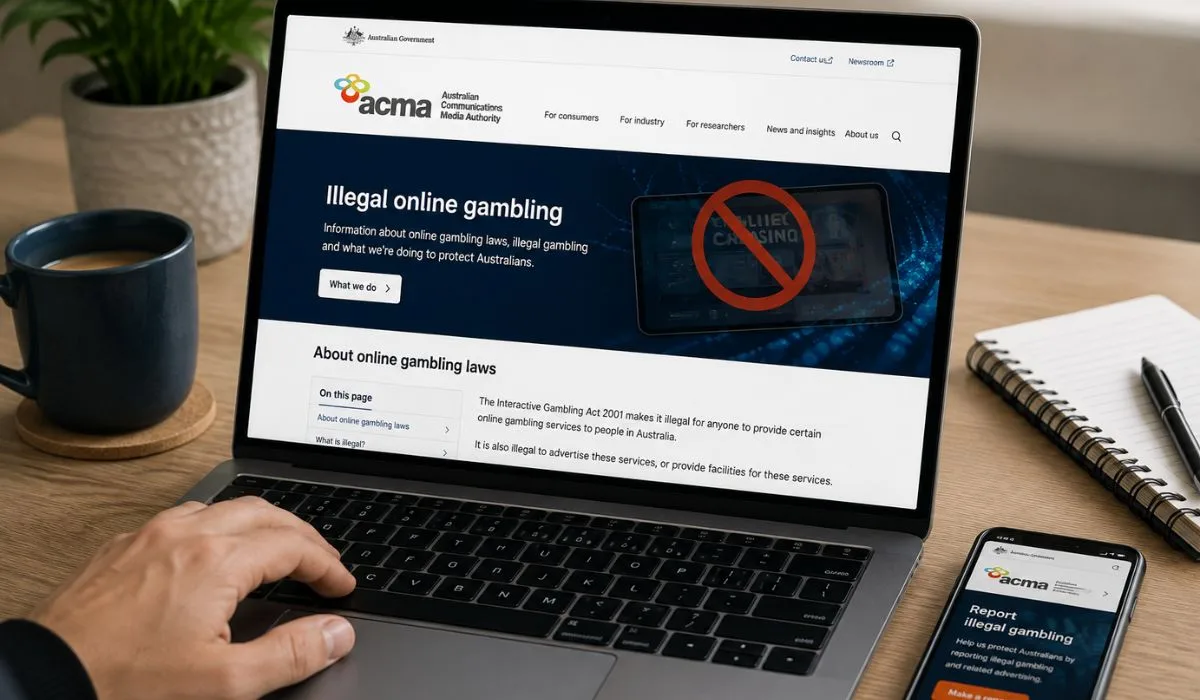
The Australian Communications and Media Authority (ACMA) enforces the IGA and can direct internet service providers to block sites operating unlawfully in Australia. ACMA publishes a list of blocked operators. Every site listed on PokiesAustralia.com is checked against this list before any recommendation.
State and territory regulators
The Northern Territory runs the most significant domestic interactive wagering licensing framework – many Australian-facing sports betting and racing sites hold NT licences, which carry their own consumer protection requirements. State-based online casino licensing doesn’t currently exist in Australia.
What this means for your protection
Australian players using offshore casinos fall outside the consumer protections that cover licensed domestic wagering. If an operator refuses withdrawal, ignores a self-exclusion request or disappears with your funds, the legal avenues are limited. This is why licence jurisdiction and dispute history are part of our audit criteria – and why we only recommend casinos with an established track record of paying out and honouring exclusions.
If a casino refuses to honour a valid self-exclusion or withdrawal request, report it to ACMA at acma.gov.au. Also notify us via the contact page – we investigate and remove operators that breach player protections.
Questions We Actually Get Asked
Does having a gambling problem mean I’m addicted?
Not necessarily. “Gambling disorder” (the clinical term) is a specific diagnosis with defined criteria. “Problem gambling” describes any gambling that causes harm – which includes a wide range of severity. You can have a problem that warrants support without meeting the threshold for a clinical disorder. The label matters less than what’s happening: if gambling is costing you more than money, it’s worth addressing.
How do I self-exclude from an offshore online casino?
Log into your account, then go to Settings → Responsible Gambling or Player Safety → Self-Exclusion. Choose your period (most reputable casinos offer 3 months to permanent). If you can’t find it, contact live chat and ask to self-exclude – state it clearly. Reputable casinos will process this immediately. For licensed Australian wagering sites (sports betting, racing), register at BetStop.com.au instead – one registration covers all participating operators.
Is the Gambling Help Online number actually confidential?
Yes. Gambling Help Online (1800 858 858) is a confidential service – counsellors do not share your information with operators, family members or authorities, unless there is immediate risk to life. The service is free. The webchat at gamblinghelponline.org.au is also confidential. You do not need to use your real name to access online chat.
My casino won’t let me self-exclude. What do I do?
Stop depositing immediately. Contact your bank and request a merchant block for that site – this prevents further transactions even if you change your mind. Report the operator to ACMA at acma.gov.au. If you’re in financial difficulty because of gambling losses or a withheld withdrawal, the National Debt Helpline (1800 007 007) offers free counselling. Also tell us about the operator via the contact page – any casino that refuses a self-exclusion request is removed from our recommendations immediately upon verification.
I’ve set deposit limits before and then raised them when I was in a session. How do I stop that?
This is a very common pattern – setting limits when calm, overriding them when playing. A few things that actually help: (1) Set limits so conservative you genuinely can’t reach your real comfort zone in one go – the 24hr cooling-off period before raising them is your protection. (2) Move to a loss limit instead of a deposit limit – it triggers on what you’ve actually lost, not just what you’ve put in. (3) If you’ve raised your limit in-session more than twice, the issue is probably deeper than a limit can fix. Talk to Gambling Help Online (1800 858 858).
Can gambling affect my mental health even if I’m not a “problem gambler”?
Yes. At any level of gambling, the wins and losses produce significant emotional swings. The anticipation, the chase, the aftermath of a big loss – these activate stress systems and can affect sleep, mood and anxiety well below the threshold of what would be called problem gambling. If gambling is producing emotional effects that are affecting your daily life, that’s worth paying attention to, regardless of what label applies.
Someone I care about has a gambling problem. What can I do without driving them away?
Gambling Help Online has a dedicated pathway for families and partners at gamblinghelponline.org.au/family-and-friends, and counsellors who specialise specifically in this situation. Key things they’ll tell you: focus on your own situation and what you can control (including protecting your shared finances) rather than trying to force the other person to stop, which rarely works. You can also call 1800 858 858 and say you’re calling about a family member – they’ll direct you to appropriate support.