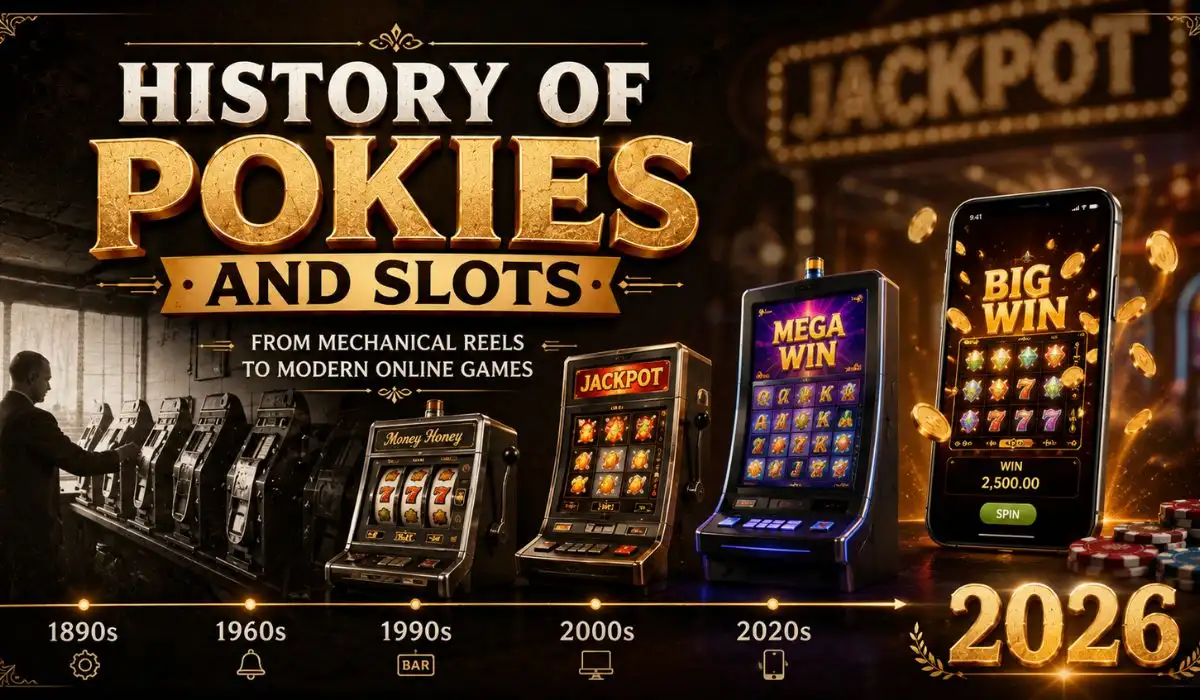

The history of pokies and slots is a 130-year story of American ingenuity, Australian legal transformation and digital revolution, depending on your perspective. It is also, frankly, the story of how a game that got banned in nearly every jurisdiction it appeared in became one of the most profitable entertainment products in human history.
Australia sits at a unique point in this story. We didn't invent the pokie machine — that was Charles Fey in San Francisco. We didn't invent video slots, progressive jackpots, or online gambling. But we produced the company (Aristocrat) that defined how the modern gaming machine works mechanically, and in 1956, we made a regulatory decision that turned pokies from a niche illegal amusement into the dominant form of Australian entertainment spending. The global gaming machine industry is, in many ways, shaped by what happened in NSW 70 years ago.
Sittman & Pitt build the poker drum machine in New York — five drums, 50 cards, no automatic payout.
Charles Fey’s Liberty Bell sets the three-reel, auto-payout template every slot machine since has followed.
NSW legalises poker machines in registered clubs — the decision that made Australia a pokies nation.
Microgaming launches the first online casino software, removing the geographic limit on where you can play.
Two Australian mechanics — Hold & Spin and Megaways — reshape land-based and online pokies within 12 months of each other.
The Origin of the Slot Machine — Sittman & Pitt and the Liberty Bell
The story of the slot machine begins not with spinning reels and coins but with playing cards and a nickel. In 1891, New York businessmen Sittman and Pitt created what is widely recognised as the prototype of the modern poker machine: a cabinet housing five drums carrying 50 card faces, based on the rules of poker.
A player inserted a nickel, pulled a lever to spin the drums, and hoped the stopped combination formed a winning poker hand. The machine had no automatic payout mechanism — prizes were paid manually by bar staff in the form of drinks, cigars or cash. Tens of thousands of these machines appeared in New York bars within a few years.
The poker drum machine had a fundamental design problem: five-card poker combinations are complex to evaluate quickly, and the absence of two cards (the 10 of spades and the jack of hearts were typically removed to reduce the odds) made it nearly impossible to track what a "fair" win actually was. What the machine needed was simplification and automatic payout.
Charles Fey and The Liberty Bell — 1894 to 1899
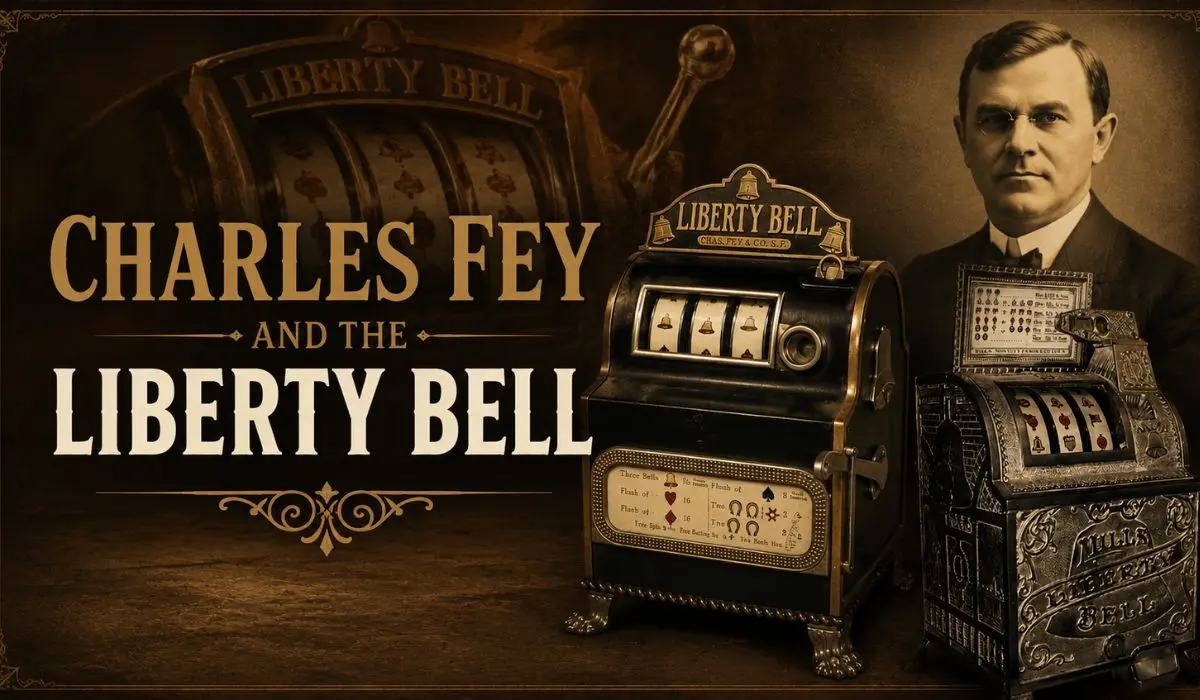
Charles Fey was a Bavarian-born mechanic who emigrated to the United States and settled in San Francisco, where he worked at the Electric Works before finally setting up his own machine shop. Between 1894 and 1899 (exact year varies), Fey created a series of progressively refined machines that solved both problems Sittman and Pitt left unsolved.
His Card Bell machine of about 1898 was the first three-reel slot to pay coins automatically. His Liberty Bell, probably made in 1899, is the machine history remembers. Three reels and five symbols (horseshoes, diamonds, spades, hearts and a cracked Liberty Bell) and a 50-cent jackpot paid automatically when three bells aligned.
1,000 possible reel combinations. A nickel per play. Fey installed and operated these machines himself in San Francisco bars and saloons, taking a share of revenue rather than selling the machines outright — a business model that still defines how gaming machines are deployed today.
Because gambling was illegal in California at the time, Fey could not patent his invention. Within a few years, dozens of competitors were producing copies. Herbert Mills of Chicago released his own Liberty Bell copy in 1907, adding one crucial element: because the machines were technically for selling gum (a legal workaround), Mills added fruit symbols — lemons, cherries, oranges, plums — matching the gum flavours on offer. These fruit symbols lasted for 130 years and can still be found on classic pokies worldwide.
Fey added the first jackpot feature in 1916, paying out all the coins in the machine at once when a winning combination was spun. He called it a jackpot. The word has been in the English language ever since.

The mechanical lever that activated Liberty Bell’s reels was on the side of the machine, like an arm. The “bandit” part reflected the machine’s tendency to take your money reliably while occasionally returning some of it. The nickname stuck even as levers were replaced by buttons in the 1960s, and survives in casual usage today.
How Slot Machines Spread Across the World — And Why They Were Mostly Illegal
The first two decades of the twentieth century saw slot machines proliferate across American bars, barber shops, cigar stores and brothels at extraordinary speed — and be banned by local governments almost as quickly as they appeared. By 1908, "bell" machines (as they were generically known) had been installed in establishments across San Francisco, Chicago and New York. By 1910, anti-gambling legislation had driven them underground in most American cities.
The machines didn't disappear — they moved. Chicago's organised crime networks took control of large portions of the slot machine distribution business in the 1920s and 1930s, installing machines across bars and clubs under protection arrangements that made the businesses' own illegality a secondary concern. The machines that weren't under mob control were seized and destroyed by reform-minded mayors; Chicago's Mayor Anton Cermak ordered more than 8,000 machines thrown into Lake Michigan in 1931 alone.
In Australia, a similar pattern played out. Illegal slot machines began appearing in NSW pubs and Victoria in the early 1900s. By the late 1920s, several thousand machines were in operation across both states, all illegal, all tolerated by an increasingly pragmatic police and political class that recognised the tax revenue potential while publicly maintaining the prohibition stance. This tension between political prohibition and practical tolerance would last three more decades before it broke in one decisive moment.
The fruit symbols on classic pokies – the cherries, lemons, oranges and bars—are a direct legacy of the American anti-gambling laws that forced slot machine operators to disguise their machines as gum dispensers. The “BAR” symbol came from the logo of the Bell-Fruit Gum Company. Every time you see those symbols on a modern online pokie, you’re looking at a 120-year-old workaround for a law that no longer exists. The visual language of slots is shaped almost entirely by the legal battles of the 1900s and 1910s. I find that remarkable.
How Australia Got Its Pokies — The Story of 1953 to 1998
Australia's relationship with pokies is unlike any other country's, and understanding why requires understanding both the Aristocrat founding story and the extraordinary sequence of state-level decisions that ran from 1956 to 1998.
1953 — Aristocrat and The Clubman
In 1953, a Sydney businessman named Len Ainsworth founded Aristocrat Leisure Limited in New South Wales. He had correctly anticipated that New South Wales was moving toward legalising poker machines in licensed clubs — a political movement that had been building for years as the post-war club industry sought sustainable revenue streams. Aristocrat's first machine, the Clubman (designed by Joe Heywood), was a three-reel mechanical device built specifically for the Australian market. In 1955, the Clubman was upgraded to the Clubmaster. One year later, the moment both machines had been designed for arrived.
1956 — The Decision that Changed Australia
In 1956, the government of New South Wales amended its gaming laws to permit poker machines in registered clubs. This single regulatory decision is arguably the most consequential gambling policy decision ever made in Australia, and possibly in the world.
The NSW model had a specific structure that shaped everything that followed: machines were legal only in not-for-profit registered clubs (RSLs, sports clubs, bowls clubs, leagues clubs), not in commercial venues or casinos. The logic was that pokies revenue would fund community organisations rather than private profit. The practical result was the creation of the most extraordinary network of gaming venues outside Nevada — but operating within a community club framework rather than a casino one. NSW clubs like Penrith Panthers RSL, Canterbury-Hurlstone Park RSL, and Revesby Workers Club would eventually become among the largest gaming venues in the world by machine count, while remaining technically not-for-profit community organisations.
Within months of legalisation, Aristocrat machines were installed across NSW clubs. The revenue was transformational. Clubs that had struggled financially rebuilt their facilities, built community centres, funded junior sports teams and provided cheap meals and entertainment to their members. The pokie machine was politically insulated from reform for decades by the genuine community benefit it funded.
The State-by-State Expansion 1973–1998
| Year | State/Territory | What Was Legalised |
|---|---|---|
| 1956 | New South Wales | Poker machines in registered clubs |
| 1973 | Tasmania | Australia's first legal casino (with pokies) |
| 1991 | Queensland and Victoria | Poker machines in clubs and hotels |
| 1992 | South Australia | Poker machines in hotels and clubs |
| 1994 | New South Wales (expanded) | Hotels and pubs (in addition to existing clubs) |
| 1994 | Victoria | Crown Melbourne opens (2,500 EGMs) |
| 1997 | Tasmania | Pokies in hotels and clubs |
| 1998 | Northern Territory | Poker machines legalised |
| Still restricted | Western Australia | Pokies legal only at Crown Perth — no pub or club machines |
Western Australia remains the sole jurisdiction in Australia where pokies are not available in pubs and clubs — only at Crown Perth casino. This produces a natural experiment in gambling policy: WA's per-capita gambling losses on EGMs are significantly lower than every other state, a data point that features in virtually every Australian problem gambling policy debate.
1995 — Two Companies, One Founder
The Australian manufacturing story didn't stay with a single company. In the mid-1990s, Len Ainsworth stepped back from the business he had built, transferring his Aristocrat holding to his family, and then did something almost nobody in their seventies does: he started again. Ainsworth Game Technology was founded in 1995 as a direct competitor to the company he had created four decades earlier, and grew into an ASX-listed manufacturer supplying machines to Australia, the United States and Latin America. Control of AGT eventually passed to the Austrian gaming group Novomatic.
Aristocrat, meanwhile, went global. Through the 2000s and 2010s it moved from being a NSW club supplier to the largest listed gaming machine manufacturer in the world, then bought its way into digital: social casino and mobile game studios were folded into the group until the digital division was generating more revenue than the physical machines. The company that started by building the Clubman for RSLs now earns a substantial share of its income from people playing free-to-play games on their phones.
1997–98 — Queen of the Nile and the Reel Power Revolution
If one machine deserves to be called the most influential Australian pokie ever built, it is Queen of the Nile. Released by Aristocrat in 1997, it paired an Egyptian theme with a free spins round that awarded a 3x multiplier and could be retriggered from inside itself — a structure so effective that it became the default free spins design for the next 25 years, copied by practically every developer in the world.
The following year, Indian Dreaming introduced Reel Power. Instead of buying paylines, players bought reels: activate all five and every symbol position counts, producing 243 ways to win. This matters for how you read the rest of this history. The variable ways-to-win structure that Megaways made famous in 2016 was not the first time an Australian company had torn up the fixed payline. Aristocrat did it in 1998, and 243-ways remains one of the most common formats in online pokies today.
Walk into any club in NSW and you’ll still find a Queen of the Nile cabinet with someone on it. Nearly thirty years. I’ve never seen another game hold a floor position that long. What Aristocrat worked out in 1997 was that the anticipation of the free spins round is worth more to a player than the round itself — the scatter landing on reel three with two already in view is the moment people are actually there for. Every developer since has built around that insight, whether they know where it came from or not.
The Numbers that Resulted
By 2026, around 200,000 electronic gaming machines will be installed in pubs, clubs, RSLs and casinos across Australia. That is why Australia has one of the highest per capita rates of poker machines in the world. Australians lose about AU$13–15 billion a year on EGMs, about 50% of total gambling expenditure nationally. In the quarter ending June 2025, New South Wales alone suffered AU$2.3 billion in losses.
I’ve played pokies in clubs and pubs across Australia for 11 years. The machines are entertaining, the community club environment they fund is genuinely valuable, and most people who play them do so recreationally without significant harm. But the honest history of pokies in Australia needs to acknowledge that the 1956 decision created an industry so profitable and politically entrenched that harm minimisation reform has often lagged behind the evidence of harm. The Productivity Commission’s 2010 report estimated that around 40% of gaming machine revenue came from people experiencing gambling harm. That’s part of the history too, and if a guide doesn’t mention it, it’s not giving the full story.
The Electromechanical Revolution — Bally, Money Honey and the Death of the Lever
For the first 60 years of the slot machine's existence, every machine was entirely mechanical: spring-loaded reels, coin mechanisms, payout levers, all moving parts. The revolution came in 1963 from a Chicago company called Bally Manufacturing — better known at the time for making pinball machines.
1963 — Bally Money Honey
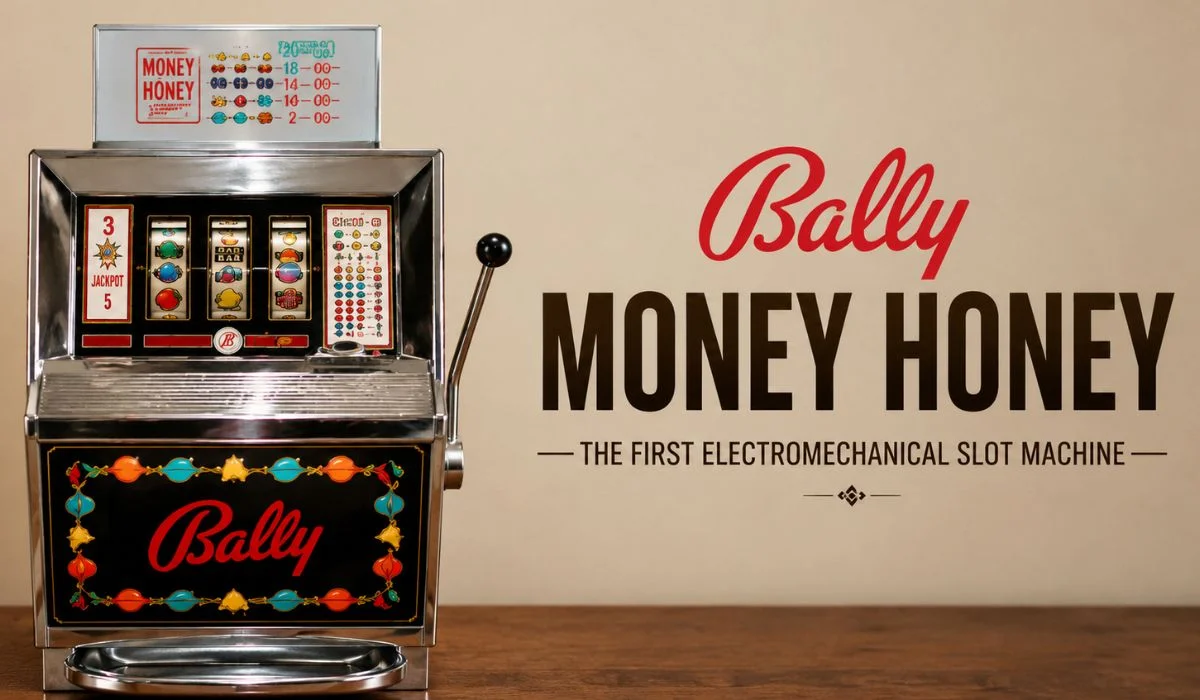
Money Honey, released by Bally in 1963 (some sources say 1964), was the first fully electromechanical slot machine. The reels still spun physically, but electric motors had replaced the spring-loaded mechanism. This single change produced a cascade of new capabilities that redefined what a gaming machine could do:
Electric motors enabled larger coin hoppers and automatic payouts of hundreds of coins without requiring an attendant.
Players could wager more than one coin per spin, increasing both potential payouts and casino revenue per play.
Electrical components introduced flashing lights, illuminated displays and electronic sound effects.
Multi-coin betting and higher-capacity coin storage made larger jackpots practical for the first time.
Money Honey retained the mechanical lever (Bally was cautious about alienating players familiar with the traditional machine), but by the early 1970s, the lever was being phased out in favour of a push button. Within a decade, slots had gone from a sideshow to the dominant revenue source on the Las Vegas casino floor, generating more income than table games.
1979 — Aristocrat Wild West and the All-Electronic Machine
In 1979, Aristocrat released Wild West, which became the world's first fully electronic gaming machine — eliminating all electromechanical components. Pure software driving digital reels, displayed on a screen. This was not a global "firsts" battle without complication (Fortune Coin had demonstrated a video slot in 1976), but Wild West's significance was that Aristocrat developed and deployed it commercially into the Australian club market — establishing the video gaming machine as the Australian standard years ahead of most international markets.
The Digital Revolution — Video Slots, RNGs and the First Progressive Jackpot
1976 — Fortune Coin and The First Video Slot
In 1976, a Las Vegas-based company called Fortune Coin Co. built the first true video slot machine in Kearny Mesa, California. The display was a modified 19-inch Sony Trinitron colour television. The machine was first exhibited at the Las Vegas Hilton Hotel and approved by the Nevada State Gaming Commission in 1977 after modifications were made to prevent cheating. In 1978, Fortune Coin Co. was acquired by International Game Technology (IGT) — the company that would go on to define the modern progressive jackpot era.
The significance of the video slot wasn't immediately obvious. A screen displaying virtual reels looked similar to the physical reel machines players were used to. The real impact came from what a screen-based game enabled: an unlimited number of potential symbols (not constrained by the physical space on a reel), complex bonus round sequences impossible with physical mechanics, and eventually the multi-payline, multi-reel format that defines modern pokies.
1984 — The RNG Patent that Made Modern Slots Possible
The Random Number Generator (RNG) is the piece of technology that makes modern pokies fair, transparent, and regulable. In 1984, Inge Telnaes received US Patent 4,448,419 for "Electronic gaming device utilising a random number generator for selecting the reel stop positions" — the first patented RNG for slot machines.
This allowed a machine's apparent reel positions to be decoupled from the underlying probability calculations, enabling game designers to set precise RTPs regardless of how many symbols appeared on each reel. IGT acquired this patent and built its video gaming empire on it.
1986 — IGT Megabucks and The Birth of Linked Progressive Jackpots
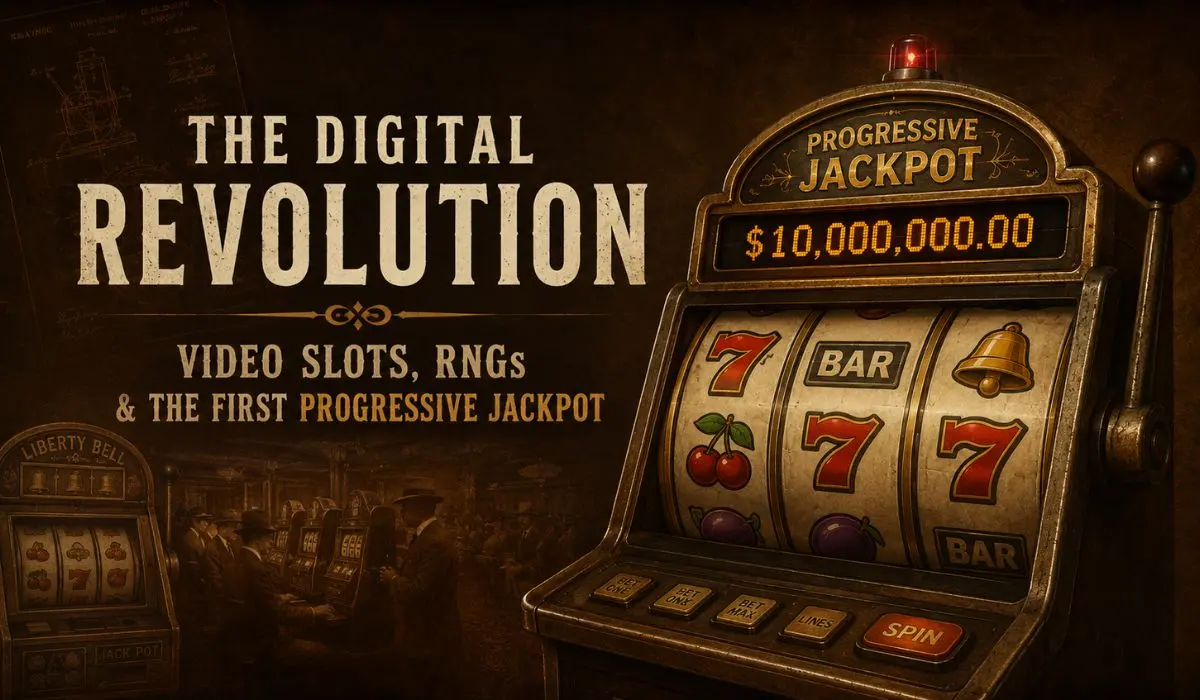
In 1986, IGT introduced Megabucks: the first linked progressive jackpot network. Individual machines across Nevada contributed a percentage of each bet to a shared jackpot displayed in real time above the machines. The jackpot grew with every spin on every linked machine until one player on any machine in the network hit the combination. The first Megabucks jackpot, paid in 1987, was $4,988,842.17 — the largest single slot machine payout in history at that time.
The linked progressive jackpot transformed the economics of slot machines. A single machine could now offer a life-changing jackpot because it was effectively pooling risk and prize money across an entire network of players. Aristocrat would later adapt this same principle for its Hyperlink, Lightning Link and Dragon Link systems — applying it to Australian clubs rather than Las Vegas casinos, but using identical structural logic.
1996 — The Second Screen Bonus Round
In 1996, WMS Industries released "Reel 'Em In" — the first slot machine with a second-screen bonus round. When a qualifying combination appeared on the main reels, the display transitioned to a separate bonus game on an additional screen. Players suddenly had an interactive element that the base game couldn't provide. This breakthrough established the framework for virtually every modern bonus round, free spins feature and interactive mini-game that Australian pokies players know today.
The Online Age — From Microgaming's First Casino to Megaways
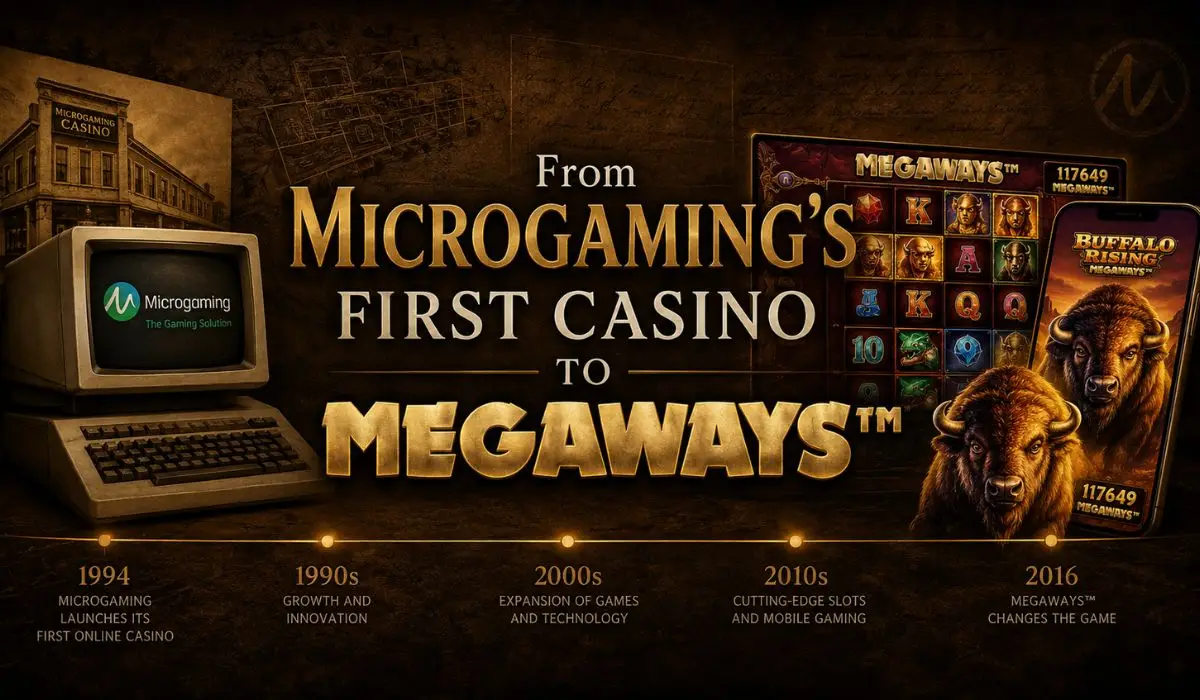
1994 — The First Online Casino
In 1994, Microgaming — a software company based on the Isle of Man — launched what is widely recognised as the world's first online casino software platform. The first games were basic three-reel slots that replicated the visual language of Las Vegas machines on a desktop computer screen.
The distribution model was the revolutionary part: any player with an internet connection anywhere in the world could access the same game. No flight to Vegas required. No club membership needed. The geographic constraint that had defined gambling since Charles Fey's saloon installations in San Francisco ceased to exist.
Microgaming was quickly joined by Playtech (1999) and Cryptologic. Early online slots were crude by modern standards — three reels, simple graphics, limited sound, modest payouts. But the foundation was laid for an industry that would eventually dwarf the land-based gaming machine market in total player numbers.
1999–2004 — Australian Online Pokies Emerge
The Gaming Club, one of the earliest Microgaming-powered online casinos, was among the first platforms accepting Australian players. In 2004, Microgaming released Thunderstruck — widely recognised as the first online slot specifically designed in the Australian pokies style, with features, volatility and visual design that resonated with Australian players familiar with land-based machines.
Thunderstruck was significant not just as a game but as proof that online pokies could replicate the land-based experience convincingly enough to capture the Australian market.
In 2001, Australia passed the Interactive Gambling Act, which restricted Australian-licensed operators from offering online casino-style games to Australian residents. Crucially, the IGA targeted operators, not players — individual Australians accessing offshore online casinos remained legal. The practical effect was that all online pokies activity by Australians shifted to offshore-licensed platforms, where it has remained ever since.
2005 — Mobile Slots and The Smartphone Era
The first mobile casino apps appeared in 2005, initially for Java-enabled phones. The experience was limited by the technology — small screens, slow connections, basic graphics. The 2007 launch of the iPhone changed the trajectory permanently.
After a few years of the smartphone era, the online casino developers had re-engineered their entire catalogues in HTML5 (replacing the Flash-based desktop originals), creating mobile-optimised experiences that played on any screen size, with no separate app download required.
The mobile platform overtook desktop as the main platform for playing pokies online by 2015. Australian players adapted faster than most markets — the combination of high smartphone penetration, 4G availability, and an existing cultural enthusiasm for pokies produced a rapid and comprehensive shift to mobile online casinos, today regard as their primary acquisition channel.
2016 — Megaways: The Mechanic that Changed Online Pokies
In 2016, Australian developer Big Time Gaming (BTG) launched Bonanza, the first commercial game to incorporate their Megaways mechanic. Instead of a fixed payline structure, Megaways games use a randomly generated number of symbols per reel on each spin, producing a different number of "ways to win" on every single spin — sometimes as few as 32, sometimes as many as 117,649. The variable ways structure creates a form of built-in volatility and unpredictability that static payline games couldn't match.
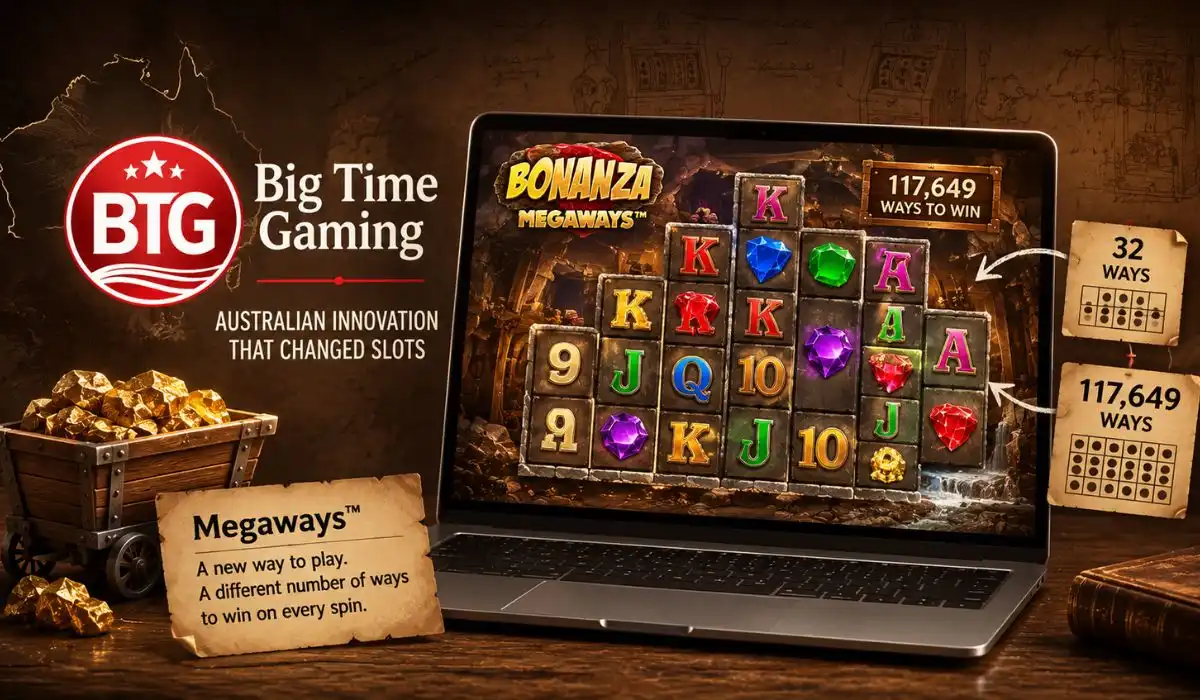
BTG allowed its Megaways mechanism to be used by other software providers; in turn, this became the number one format for new online casino slots in 2019. Pragmatic Play, NetEnt, Blueprint Gaming, Hacksaw Gaming, and many more large development companies all launched Megaways games. The mechanic has been cited as the single most significant innovation in online slots since the video screen. Ironically for Australian pokies history, it came from an Australian company — demonstrating that Australia's contribution to global slot machine innovation didn't end with Aristocrat.
Online Pokies in 2026 — What the Modern Game Actually Looks Like
The online pokies of 2026 bear the same relationship to Charles Fey's Liberty Bell as a modern aircraft does to the Wright Flyer: same fundamental principle (random outcome, paid bet, returned prize), transformed beyond recognition in almost every other respect.
| Feature | Liberty Bell (1899) | Modern Online Pokie (2026) |
|---|---|---|
| Reels | 3 physical reels | Up to 6+ virtual reels |
| Symbols | 5 (horseshoe, diamond, spade, heart, bell) | Unlimited (full thematic design) |
| Ways to win | 3 (one payline) | Up to 117,649 (Megaways) |
| Bonus features | None | Free spins, Hold & Spin, bonus rounds, Bonus Buy, cascades, multipliers, gamble features |
| Jackpot | 50 cents (10 nickels) | AU$20+ million (progressive networks) |
| RTP transparency | Unknown | Published per game (typically 94%–97%) |
| Where played | San Francisco saloons | Any device, anywhere |
| Regulation | Illegal (couldn't patent) | Licensed, audited, RNG-certified |
Full History of Pokies & Slots — 1891 to 2026
Five drums, 50 card faces, poker combinations, nickel per play, manual payout. Installed in hundreds of New York bars. No automatic payout mechanism. The direct predecessor of the modern slot machine.
Three reels, five symbols, automatic 50-cent coin payout. The Liberty Bell established the template for every slot machine built since. Installed in San Francisco bars; could not be patented as gambling was illegal in California.
Mills Novelty Co. produces the first mass-market Liberty Bell copy. Fruit symbols (cherry, lemon, orange, plum) were added to disguise machines as gum dispensers under anti-gambling laws. The “BAR” symbol from the Bell-Fruit Gum Company appears. Fruit symbols survive to modern pokies.
One winning combination pays out the entire coin hopper. Fey names it the jackpot. The word enters the English language.
Slot machines imported from the US and UK begin appearing in NSW and Victorian pubs and clubs, all illegal, most tolerated by a pragmatic political class aware of their revenue potential.
Len Ainsworth founded Aristocrat Leisure Limited in NSW. First machine: the Clubman (designed by Joe Heywood). A three-reel mechanical machine built for the Australian market. Upgraded to the Clubmaster in 1955.
The most consequential gambling decision in Australian history. Pokies legal in registered clubs (RSLs, sports clubs, bowls clubs) — not commercial venues. Aristocrat machines were installed immediately. The community club gaming model that defines Australian pokie culture is established.
Bottomless hopper, 500-coin automatic payout, multi-coin bets, electrical lights and sounds. The lever is retained for familiarity but will be phased out by 1970. Slots become Las Vegas’s dominant revenue source within a decade.
The Wrest Point Casino in Hobart becomes Australia’s first legal casino. Pokies are part of the offering. The casino model in Australia begins its parallel development alongside the club model.
19-inch Sony Trinitron TV display. First exhibited at the Las Vegas Hilton. Nevada Gaming Commission approval in 1977. Fortune Coin Co. was acquired by IGT in 1978. The video screen replaces physical reels and unlocks modern game design.
Pure electronic machine deployed commercially in Australian clubs. Aristocrat establishes the video gaming machine as the Australian standard. The mechanical era is over.
US Patent 4,448,419 awarded to Inge Telnaes — the Random Number Generator that decouples apparent reel positions from underlying probability. IGT acquires the patent. Modern regulated slot machines have become possible.
Machines across Nevada are linked into a shared jackpot pool. First Megabucks jackpot paid in 1987: $4,988,842.17. The linked progressive jackpot concept that underpins Aristocrat’s Lightning Link and Dragon Link is born.
Three more Australian states legalise gaming machines. Queensland (1991), Victoria (1991) and South Australia (1992) opened their markets. The pokie machine entered Australian pubs and hotels for the first time alongside clubs.
The first online casino software platform. Early slots: three reels, basic graphics, familiar symbols. The geographic restriction on gambling is permanently removed. Australian players gain access immediately.
Players are taken to a separate screen for an interactive bonus game. The framework for every bonus round, free spins feature and pick-and-click game that exists in modern pokies is established here.
Restricts Australian-licensed operators from offering online casino games to Australian players. Does not criminalise individual players. Australian online casino play shifts entirely to offshore-licensed platforms.
The first online slot designed in the Australian pokies tradition. Proves that the online format can capture the Australian land-based experience. Opens the floodgates for European developers building for the AU market.
The smartphone revolution transforms online gambling. By 2015, mobile surpassed desktop as the primary platform for online pokie play in Australia. Developers rebuild catalogues in HTML5 for any-screen play.
Australian developer Big Time Gaming releases Bonanza, the first Megaways game. Up to 117,649 ways to win per spin. BTG licenses the mechanic globally. The most significant innovation in online slots since the video screen was created in Australia.
The Interactive Gambling Amendment (Credit and Other Measures) Act 2023, effective June 2024, bans credit card deposits for online gambling in Australia. PayID and cryptocurrency have become the dominant deposit methods for Australian online casino players.
Australia has ~200,000 land-based EGMs generating AU$13–15bn in annual player losses. Online pokies at offshore-licensed casinos serve millions of Australian players. The Liberty Bell’s fundamental principle — bet, spin, random outcome, automatic payout — underpins every spin.
Conclusion: What Changed Most — and What Didn't
The mechanics that have changed most dramatically are bonus features and progressive jackpot structures. The Hold & Spin mechanic (Aristocrat's signature, powering Lightning Link and Dragon Link) didn't exist until the 2000s. Megaways didn't exist until 2016. Bonus Buy features — paying a premium to skip directly to the bonus round — are a 2020s development. The game design space has expanded vastly in the last 20 years.
What hasn't changed: the fundamental loop of bet, spin, outcome. The psychological structure of variable-ratio reinforcement that makes pokies compelling — the unpredictability of when a win arrives — is the same mechanism Sittman and Pitt built into their poker drum machine in 1891. Every feature, mechanic and visual elaboration of the last 130 years sits on top of that unchanged core.