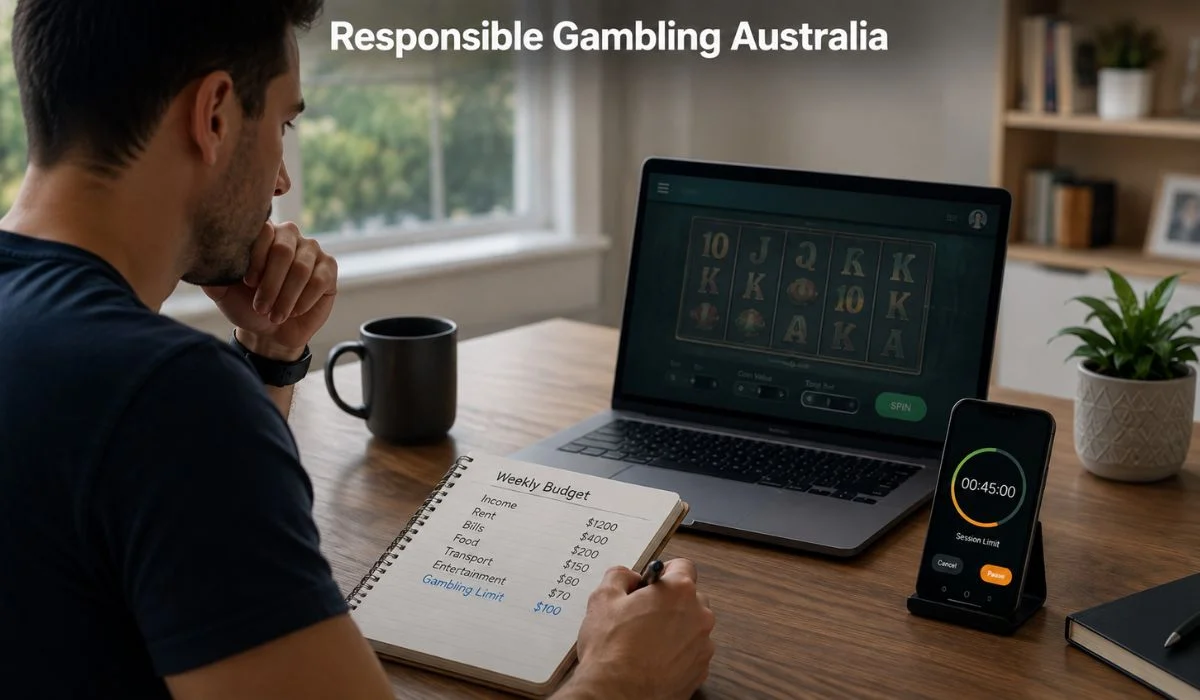
Our Commitment to Player Safety
At PokiesAustralia.com, responsible gambling is not a legal disclaimer – it’s a core part of how we operate. We only recommend casinos that provide meaningful responsible gambling tools. We refuse commissions from operators that make it difficult for players to set limits or self-exclude. And we maintain this page as a genuine resource, not a box-ticking exercise.
Pokies are designed to be enjoyable. The vast majority of people who play them do so without harm. But gambling disorder is real, it affects real Australians, and it deserves to be taken seriously. If something on this page is relevant to you or someone you know, please use it.
All casinos we recommend must: display responsible gambling tools prominently, offer deposit limits and session limits, provide self-exclusion options, link to Australian helplines, and have a clear process for players to close their accounts.
Australian Gambling Support Services
Every service listed below is free, confidential and staffed by trained professionals. You do not need to have a gambling problem to call — these services help anyone who is worried about their gambling or someone else’s.
Australia’s primary gambling support helpline. Trained counsellors available around the clock by phone or online chat. Completely free and confidential. Available to players and their families.
Prefer to type rather than talk? Gambling Help Online offers live chat with a counsellor directly on their website – instant, anonymous and free.
If gambling is affecting your mental health like anxiety, depression, relationship stress; Beyond Blue provides free 24/7 mental health support alongside gambling-specific referrals.
Friends and family members affected by someone else’s gambling can access free counselling, support groups and practical advice specifically tailored to their situation.
If you’re in a crisis or having thoughts of suicide related to gambling debt or losses, Lifeline is available 24/7. You are not alone and help is available immediately.
Free financial counselling for Australians dealing with gambling-related debt. Professional advisers help you understand your options and create a plan to address financial hardship.
Signs of Problem Gambling
Problem gambling doesn’t always look obvious. It can develop gradually and affect people who consider themselves in control. These are the most common warning signs – in yourself or someone close to you.
Gambling more to try to win back money already lost, often increasing bets in the process.
Concealing how much time or money is spent gambling from family, friends or a partner.
Using credit cards, loans or money from family to fund gambling – especially to cover losses.
Feeling restless, anxious or irritable when trying to cut back or stop gambling.
Consistently playing for longer or spending more money than you intended when you started.
Using gambling as a way to cope with stress, anxiety, depression or difficult life situations.
Work, family or social obligations being missed or neglected because of gambling activity.
Making repeated unsuccessful attempts to control, cut back or stop gambling altogether.
Recognising one or more of these signs doesn’t mean you have a gambling disorder – but it may be worth talking to someone. Gambling Help Online (1800 858 858) can help you work out what level of support, if any, is right for you.
Gambling Self-Assessment
Answer these 10 questions honestly. This is based on the Brief Biosocial Gambling Screen (BBGS) and Problem Gambling Severity Index – the same tools used by Australian health professionals. Your answers are not stored or sent anywhere.
10-Question Self-Check
Answer Yes or No for each question based on the past 12 months.
This tool is for informational purposes only and does not constitute a clinical diagnosis. If you are concerned about your gambling, please contact Gambling Help Online: 1800 858 858.
Self-Exclusion in Australia
Self-exclusion is one of the most effective tools available for people who want to take a break or stop gambling altogether. In Australia, there are two main routes depending on where you gamble.
STOP
BetStop is the Australian Government’s national self-exclusion register. Once registered, you will be excluded from all licensed Australian sports betting and wagering services simultaneously – you only need to register once.
Go to the official BetStop website. Registration is completed online and typically takes about five minutes, according to BetStop.
You’ll need to provide your name, date of birth and contact details. Identity verification is required to ensure your exclusion is applied correctly.
Select how long you want to self-exclude – from 3 months up to a lifetime exclusion. The minimum exclusion period is three months. Longer exclusions may have specific cancellation requirements after the initial three-month minimum has been completed.
All participating operators are notified and your accounts are suspended. You will receive a confirmation email once the exclusion is active.
BetStop covers licensed Australian wagering providers. For offshore online casinos, contact each casino’s support team directly via their responsible gambling settings to request self-exclusion.
Self-excluding from offshore online casinos
Offshore casinos (including most online pokies sites) are not covered by BetStop. To self-exclude from an online casino, log into your account and look for the Responsible Gambling or Player Protection section in your account settings. You can usually select a self-exclusion period ranging from 24 hours to permanent.
If you can’t find this option, contact the casino’s live chat or email support and request a self-exclusion directly. All casinos we recommend are required to process self-exclusion requests immediately upon request.
Responsible Gambling Tools and Limits
Reputable online casinos offer a range of tools to help you stay in control of your gambling. These should be available in your account settings – look for a “Responsible Gambling” or “Player Safety” section.
Set a maximum amount you can deposit daily, weekly or monthly. Limits take effect immediately and cannot be raised for 24–72 hours – giving you a cooling-off buffer.
Set a maximum session length. Once the limit is reached, you’ll be logged out automatically — useful for preventing extended play when you planned to stop earlier.
Periodic notifications showing how long you’ve been playing and how much you’ve wagered during a session. Helps you stay aware of time and money spent.
Set a maximum loss per day, week or month. Once you reach it, your account is restricted until the period resets — prevents chasing losses beyond a set threshold.
Take a short break of 24 hours, 7 days or 30 days without a full self-exclusion. Account access is suspended for the chosen period without permanently closing your account.
Close your account for a set period or permanently. Exclusions take effect immediately. Most casinos will not reopen an excluded account until the exclusion period has fully elapsed.
Deposit and withdrawal limits at our recommended casinos
| Limit type | Typical options | Takes effect | Can be raised |
|---|---|---|---|
| Deposit limit | Daily / weekly / monthly AUD cap | Immediately | After 24–72hr cooling-off |
| Loss limit | Daily / weekly / monthly loss cap | Immediately | After cooling-off period |
| Session time limit | 30 min / 1hr / 2hr / custom | Immediately | Next session login |
| Cool-off period | 24hrs / 7 days / 30 days | Immediately | Cannot be shortened |
| Self-exclusion | 3 months to permanent | Immediately | Only after full period ends |
Tips for Safer Gambling
The following principles won’t change your odds – pokies are games of chance and no strategy changes that. But they can help you keep gambling in its proper place: as entertainment, not a financial strategy or emotional crutch.
Before you play
Set a budget and stick to it. Decide how much you’re willing to spend before you open the casino. Treat it as the cost of entertainment – like a night out – not as an investment. Once it’s gone, the session is over.
Set a time limit. Decide in advance how long you’ll play. Use the casino’s session timer if available, or set an alarm on your phone. Pokies are designed to be absorbing – external time prompts help.
Don’t play to recover losses. The biggest risk in pokies is chasing. Each spin is independent – previous losses have no bearing on future outcomes. If you’ve hit your loss limit, stop. The machine won’t start paying out because you’ve been playing long enough.
While you play
Never gamble with money you need. Bills, rent, groceries, family expenses – these should never be part of your gambling budget. If you find yourself thinking about gambling with essential funds, that’s a sign to stop and seek support.
Take regular breaks. Get up, walk away from the screen, drink some water. Extended sessions without breaks make it harder to make clear decisions about whether to continue.
Don’t gamble when emotional. Stress, loneliness, anxiety and boredom are common triggers for problem gambling. If you’re playing to feel better about something unrelated to gambling, that’s worth reflecting on.
Understand the RTP. Online pokies return between 94–97% of money wagered over time – but this is a statistical long-term average across millions of spins. In any individual session, you could win or lose significantly more. The house always has an edge.
Keep it honest
Ask yourself regularly: Am I still enjoying this? Would I be comfortable if my family knew how much I was spending? Is gambling taking up time or money I can’t really spare? If the answers concern you, the resources on this page are here to help.
Gambling Law in Australia
Australian gambling law operates across both federal and state levels. Understanding the framework helps you make informed decisions about where and how you play.
The Interactive Gambling Act 2001
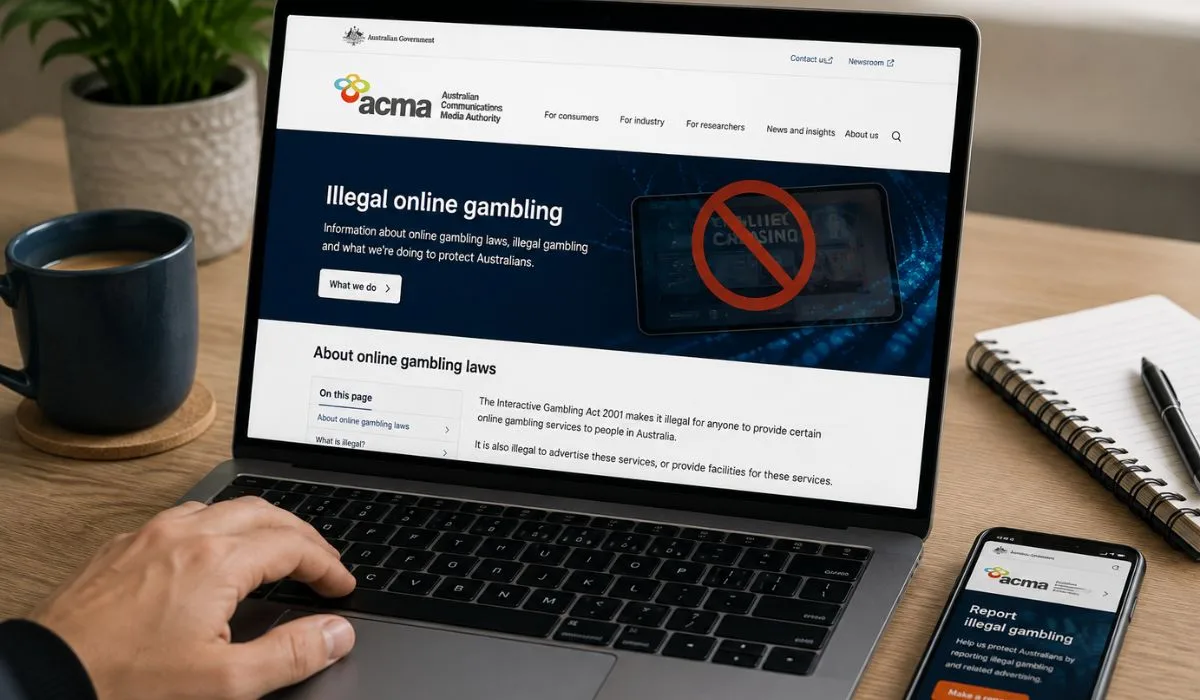
The Interactive Gambling Act 2001 (IGA) is the primary federal law governing online gambling in Australia. It prohibits Australian-based operators from providing interactive gambling services to Australian residents without an appropriate licence. However, it does not make it illegal for Australian players to access offshore gambling sites.
ACMA’s role
The Australian Communications and Media Authority (ACMA) enforces the IGA at a federal level. ACMA has the power to direct internet service providers to block access to illegal offshore gambling sites. ACMA investigates illegal online gambling services and can request that Australian internet service providers block websites found to be operating in breach of the IGA. ACMA publishes details of its website-blocking actions. All casinos listed on PokiesAustralia.com are assessed against ACMA’s publicly available prohibited list.
State and territory regulators
Individual states and territories also regulate gambling within their jurisdictions. The Northern Territory operates the most significant domestic interactive wagering licence framework in Australia – many licensed Aussie-facing sports betting sites operate under NT licences.
Your rights as a player
Australians using offshore online casinos may not receive the consumer protections available through Australian-licensed wagering services. Account closure, self-exclusion, withdrawal of remaining balances and dispute-resolution procedures can depend on the operator, its licence and applicable jurisdiction. ACMA warns that Australians using illegal gambling services risk losing their money. If a casino refuses these requests, we encourage you to report the operator to ACMA via acma.gov.au.
Responsible Gambling FAQ
What is problem gambling?
Problem gambling is when gambling stops being entertainment and starts causing harm – financial, emotional or social. It’s characterised by chasing losses, gambling with money you can’t afford to lose, hiding gambling from family, and feeling unable to stop. It can affect anyone regardless of how long they’ve been gambling or how much they earn.
How do I self-exclude from online casinos in Australia?
For licensed Australian wagering providers (sports betting, racing), register at BetStop.com.au – one registration excludes you from all participating operators. For offshore online casinos, log into your account settings and look for the Responsible Gambling or Player Safety section. If you can’t find it, contact live chat and request self-exclusion directly. All reputable casinos will process this immediately.
Is the Gambling Help Online helpline really confidential?
Yes. Gambling Help Online (1800 858 858) is a completely confidential service. Counsellors do not share your information with anyone – not with gambling operators, not with family members, and not with authorities – unless there is an immediate risk to your life or the life of someone else. The service is also free of charge.
Can I set deposit limits at online casinos?
Yes. Most reputable online casinos – including all those we recommend – allow you to set daily, weekly and monthly deposit limits from within your account settings. These limits take effect immediately and cannot typically be increased for 24–72 hours. This cooling-off period is an important feature: it means a decision made in a good moment of clarity protects you even when you later feel the urge to raise the limit.
What if my casino won’t let me self-exclude?
A casino that refuses to honour a valid self-exclusion request raises a serious player-safety concern and may be breaching its licence conditions or applicable regulations. If this happens, immediately contact ACMA at acma.gov.au to report the operator. You should also stop depositing to the site and contact your bank to block transactions to that merchant. If you’re in financial difficulty as a result, contact the National Debt Helpline on 1800 007 007 for free financial counselling.
Can gambling affect my mental health?
Yes. Problem gambling is strongly associated with anxiety, depression, stress, relationship breakdown and in severe cases, suicidal thoughts. If gambling is affecting your mental health, please reach out to Beyond Blue (1300 22 4636) or Lifeline (13 11 14) alongside gambling-specific support. You don’t need to wait until things are crisis level – support is available at any point.
My family member has a gambling problem – what can I do?
Gambling Help Online has a dedicated service for families and friends affected by someone else’s gambling, available at gamblinghelponline.org.au/family-and-friends. They can help you understand your situation, protect your own finances, and support your family member in a healthy way. You can also call 1800 858 858 and specify that you’re calling about a family member’s gambling.